COP30 Brazil: Building a People-Centered Transparency Framework
Message from Raphael Edou, Founder & CEO of Radenamias LLC, to the High-Level Ministerial Meeting on the Enhanced Transparency Framework (ETF)
Former Minister of Environment, Climate Change, Forest and Natural Resources of Benin; Former Deputy Mayor of Cotonou in charge of the Local Climate Action Plan; Former Africa Program Manager at the Environmental Investigation Agency (Washington DC); Former National Coordinator of Bethesda Benin NGO; winner of the Japanese International Award for Most Innovative Projects and the Dubai International Award for Best Practices.
Bridging cultural and economic connections between Francophone Africa and the United States
5000 Thayer Center, Suite C, Oakland, MD 21550 USA
Tel: +1 240 355 7163 | Email: info@radenamias.com
At COP30 in Brazil, ministers and senior leaders are gathering for a high‑level dialogue on the [Enhanced Transparency Framework (ETF)]. The ETF is central to the Paris Agreement because it specifies how parties must report progress on reducing greenhouse‑gas emissions, adapting to climate impacts and providing support. Yet transparency alone does not guarantee impact. Reports must resonate with the citizens whose lives are at stake. Only then will transparency translate into trust and better decision‑making.
As a former minister, city leader, NGO coordinator and international advocate, I have witnessed firsthand the gulf that can open between reporting and reality. Today, through Radenamias LLC, I work with communities across Africa and with global partners to bridge that gap. I believe we can move beyond “tick‑box” reporting to a model that treats people as clients, not statistics.
1 – The first ETF cycle is a milestone – but it must speak to citizens
The first ETF cycle is a collective achievement and a testament to the hard work of many countries. But transparency will not be credible if it remains a dialogue between experts and negotiators. When a country reports progress on forests, cities and energy, local communities must be able to say, “Yes, we can see it. It is changing our lives.” The ETF should be a mirror where citizens recognize the realities they live and where decision‑makers listen and respond.
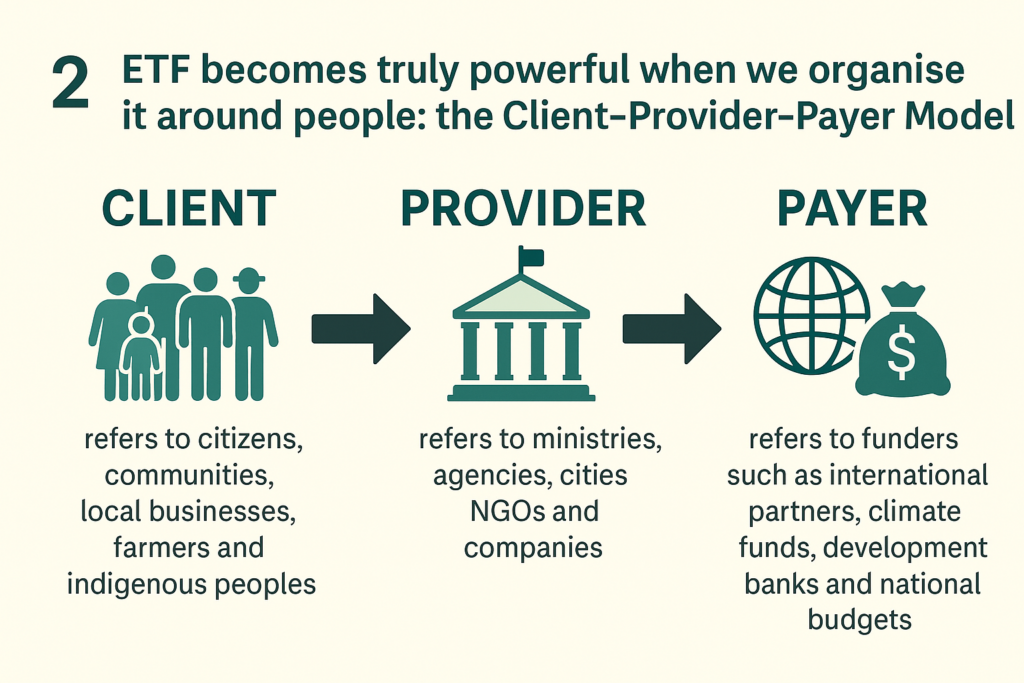
ETF becomes truly powerful when we organise it around people: the Client–Provider–Payer Model. To make the ETF fully effective for the implementation of the Paris Agreement, we need to organise transparency around those we serve. I developed the Client–Provider–Payer Model (CPPM) to do exactly that. The Client refers to citizens, communities, local businesses, farmers and indigenous peoples who should benefit from climate and nature policies. The Provider refers to ministries, agencies, cities, NGOs and companies that implement projects and programmes. The Payer refers to funders such as international partners, climate funds, development banks and national budgets.
2 – ETF becomes truly powerful when we organise it around people: the Client–Provider–Payer Model
To make the ETF fully effective for the implementation of the Paris Agreement, we need to organise transparency around those we serve. I developed the Client–Provider–Payer Model (CPPM) to do exactly that. The Client refers to citizens, communities, local businesses, farmers and indigenous peoples who should benefit from climate and nature policies. The Provider refers to ministries, agencies, cities, NGOs and companies that implement projects and programmes. The Payer refers to funders such as international partners, climate funds, development banks and national budgets. Too often, climate projects become a conversation only between Payers and Providers, while the Client is treated as an afterthought.
By applying CPPM together with the ETF we can change this dynamic:
- ETF tells us what must be reported and reviewed under the Paris Agreement.
- CPPM organises for whom we work and to whom we are accountable.
In practice this means that when preparing ETF reports we ask not only “What are the emissions and policies?” but also “Who are the clients and how are their lives improving?” Providers report not only upwards to the Payer but also back to the Client using clear and accessible language. Payers use ETF data and feedback from clients to decide which actions to scale up, which ones to correct and which innovations to support. This combination turns transparency into a governance instrument. It helps to reduce environmental crime and illegal logging, improve forest and land‑use management, ensure that climate and nature policies reach local communities and indigenous peoples, and strengthen confidence in public institutions and international cooperation.
3 – ETF + CPPM can align climate finance with real transformation on the ground

The ETF already provides a common framework for reporting on emissions, adaptation and climate finance. CPPM adds a practical lens to ensure that success is not measured only by megawatts installed, hectares reported or dollars disbursed, but by clients whose lives are demonstrably improved.
In a CPPM‑ETF approach we measure success by farmers who are more resilient and better informed about climate risks, communities who see deforestation decreasing and their rights respected, and cities that offer cleaner air, better mobility and greater protection from floods and heat.
When these realities are integrated into our transparency reports, climate finance becomes more effective and equitable, funders see clearly where their support is changing lives and where it is not, and countries can better justify and attract investments for fair and sustainable transitions.
A personal conclusion
Excellencies, colleagues and partners: the Enhanced Transparency Framework gives us a strong international backbone – a common language and set of rules. Let us now complement it with practical models like the Client–Provider–Payer Model to ensure that our climate and nature actions are people‑centered, locally grounded and focused on real impact.
My experience spans from designing national policies to implementing local climate actions and investigating environmental crimes. Now, as the head of a company dedicated to empowering communities and bridging continents, I see the urgent need to re‑imagine accountability. Radenamias LLC stands ready to support governments, NGOs and funders in adopting the Client–Provider–Payer Model and building the digital tools and transparent systems that make it work. Together we can make every ETF cycle not only a technical progress report but a story of lives improved, trust rebuilt and investments delivered where they matter most.
About Radenamias LLC
Radenamias LLC
bridges cultural and economic connections between Francophone African countries and the United States and offers services designed to foster cultural pride, economic empowerment and mutual prosperity.
Our mission is to provide expert advice and assistance for projects involving Africa and the US, encouraging strategic partnerships and positive change.
 English
  French